
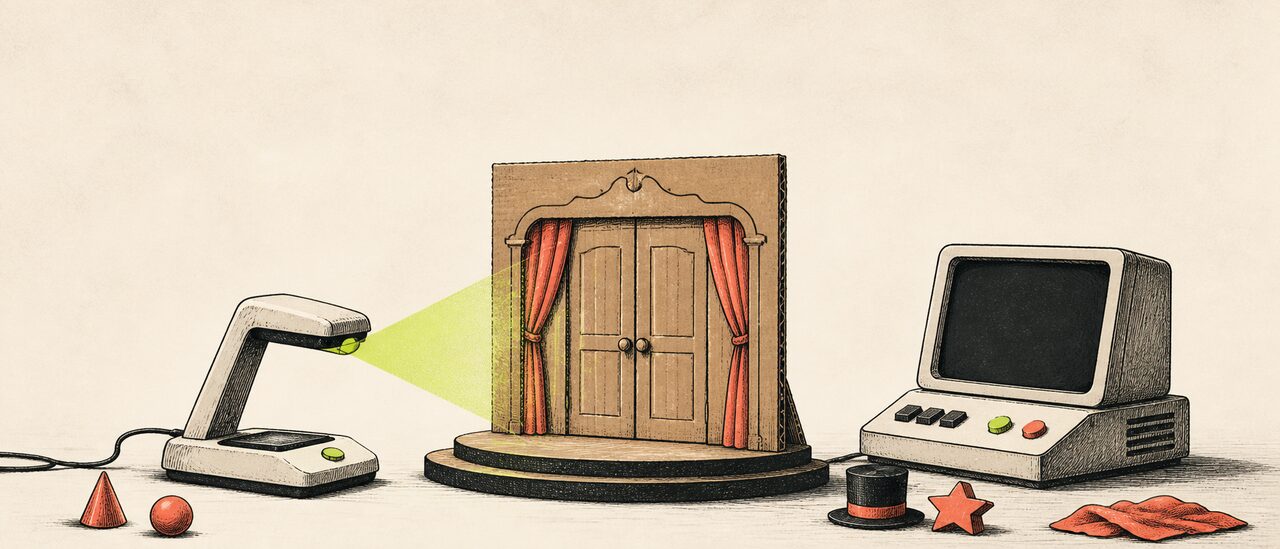
A real program on a movie screen is a lovely detail. It is also a very small witness. It can confirm that someone in the production knew the name of a tool. It cannot, by itself, confirm everything the character does after pressing Enter.
These four examples use the Nmap project’s catalog of film appearances for the scene details. The judgments are our own. This is not a claim to have independently reconstructed every keystroke, and it is not a tutorial for repeating an intrusion. It is a look at the gap between a credible prop and the work a story asks that prop to perform.
For a broader cast beyond these four scenes, our ranking of movie hackers compares what the characters attempt with what their tools could support.
The Matrix Reloaded: the scanner gets a supporting role
The Nmap team describes Trinity using its scanner to identify a vulnerable SSH service, followed by a separate exploitation step. That sequence is why this scene earns more credit than a generic glowing globe labeled with an emergency.
The distinction matters. A discovery tool can help establish what is present. A later action has to establish whether access is possible. A story that shows both has preserved at least part of the causal chain. It has allowed the screwdriver to remain a screwdriver instead of promoting it to universal building key.
That does not turn a short scene into a complete demonstration of how a power system works. The audience still sees a selected sequence, with the surrounding conditions supplied by the story. It is fair to praise a particular technical detail without awarding the whole fictional operation a certificate.
The joke is that the least spectacular part of the scene does useful work. A recognizable tool and a separate next step tell a more coherent story than a screen that simply announces success in a larger font. Sometimes realism is the decision to show one extra verb.

The Bourne Ultimatum: a mail server is not a mailbox
The project’s catalog identifies Nmap and its graphical interface, Zenmap, during the film’s attempt to reach a newspaper mail server. It also notes the visible service information. Those are specific observations about the screen, not proof that scanning a server reveals its messages.
The official Nmap reference describes network discovery and security auditing. Its output can identify hosts and report service or port information. An open port means an application is listening there. It does not mean a stranger has been handed the contents of an email account.
This is where movie language can quietly move too fast. The character says the target is a mail server. The screen displays technical output. The scene moves toward the desired information. The audience can connect those beats even if an important authorization or access step has never been explained.
Think of a building directory. Learning which floor contains the records office is useful. The directory has not opened a locked filing cabinet. It would be unreasonable to blame the directory for that limitation, and equally unreasonable to congratulate it for the entire burglary.
A good critique therefore names the missing relationship. “Computers do not work like that” is a satisfying noise, but it explains very little. “The scan result does not establish access to the mailbox” points to the actual jump. It also lets the real tool keep its dignity.
Snowden: the timer is not a benchmark
In the catalog’s account of Snowden, a training challenge expected to take several hours is completed in 38 minutes, with Nmap and a custom script visible. That is a dramatic comparison inside the film. It is not a published performance test for the software.
A timer is an efficient character introduction. The audience does not need to understand the whole assignment to understand that this person finished unusually quickly. The clock supplies the judgment while the terminal supplies the atmosphere.
What it cannot supply is a fair comparison between real practitioners. To compare completion times, you would need the same task, starting information, environment and definition of done. You would also need to know what was automated beforehand. A script arriving at the start line has already brought some earlier work with it.
That is not a complaint that a drama should pause for a methods appendix. It is a boundary on the inference a viewer can make. The scene communicates ability within its story. A person watching at home should not turn the number into a personal deadline for learning a security tool.
There is enough anxiety in technical work without being measured against an editor who can remove the waiting. The fictional stopwatch has excellent working conditions. It never needs to install a missing dependency unless that would improve the scene.
Extracted: a real tool in an impossible machine
The Nmap catalog also records the tool appearing in Extracted as part of a system for entering a person’s memories. Here, the mismatch is larger than a skipped login step. Network scanning does not establish a mechanism for walking into a mind.
A recognizable technical component can make a speculative machine feel less anonymous. The audience sees something that belongs to the real world, then carries a little of that familiarity into the invented part. The effect is useful for production design even when it supplies no scientific support.
The fair response is to keep those two jobs separate. As a screen detail, the tool can lend texture. As evidence that the fictional machine could exist, it contributes nothing comparable. Putting a genuine thermometer on a time machine would not settle the argument about time travel.
This example also shows why a list of real software appearances is different from a list of accurate hacking scenes. A cameo is observable. Accuracy needs a defined claim to evaluate. Without that distinction, a prop gets asked to vouch for the entire screenplay.
How to watch the next terminal scene
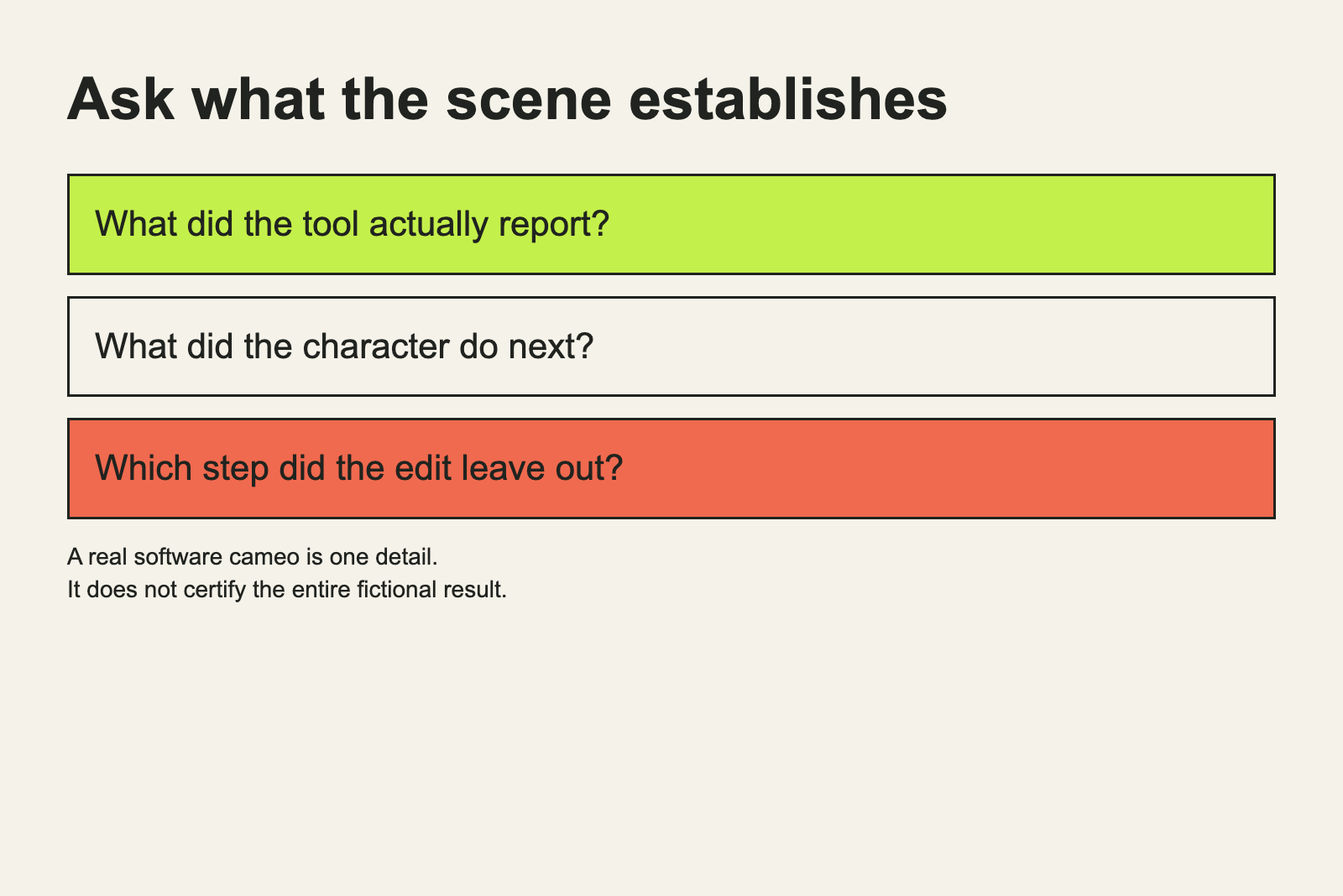
Ask what the screen actually establishes. Did it find a system, identify a service, display information already available to the character or show a result that requires another explanation? Then ask which part the film leaves to editing. The missing step is often more interesting than the brand of laptop.
The fictional interface article looks at the designers’ side of that bargain. The broader collection of things code does not do in real life covers the recurring habits. Here, the verdict is narrower: a real tool deserves credit for the job it can actually do. The rest of the scene still has to make its own case.