
A convincing hacker scene needs more than a real command on the screen. The character also needs a reason for trying it, a way into the system and enough time to learn something from the result.
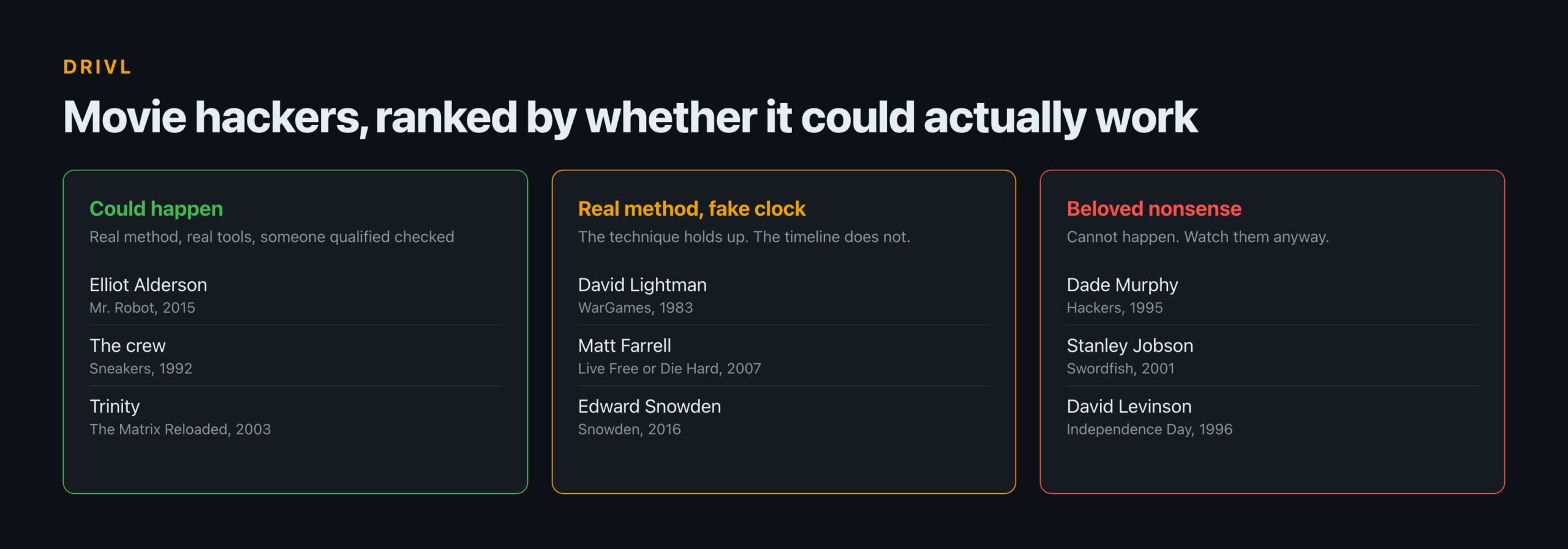
These are selected film hackers, with Mr. Robot as a television comparison. The groups reflect how convincing their methods are, rather than how much the characters can accomplish inside their fictional worlds.
The more grounded portrayals
The crew in Sneakers
Sneakers gives its team practical jobs: persuade someone, enter a building, get close enough to learn something. Its appeal comes from watching people coordinate a plan. The computer does not have to supply all the suspense.
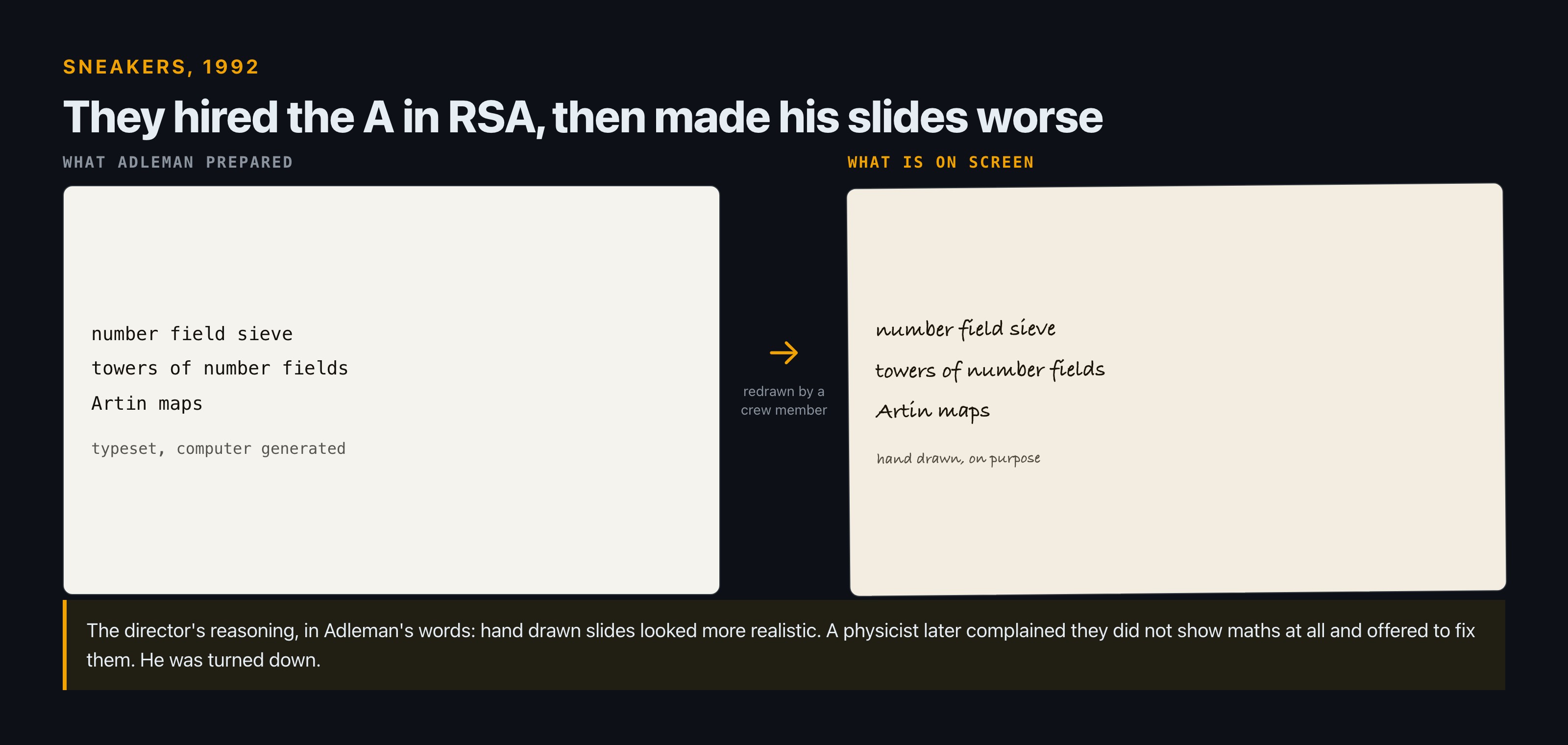
The production also recruited cryptographer Len Adleman. In his account of consulting on the film, he describes preparing mathematical slides that the crew then redrew by hand because handwriting looked more believable on camera.
That is a wonderful little reversal. The expert supplied the work. The production supplied the appearance of work. A later objection to the slides only makes the story better: accuracy still had to survive being turned into a prop.
Elliot Alderson in Mr. Robot
The television comparison earns a place because it makes the process visible. Hackaday’s first-season review describes recognizable tools, visible commands and social engineering.
A conversation can be as consequential as the terminal. That gives the viewer a chain of decisions to follow instead of a brilliant person staring at a password prompt until brilliance takes effect.
The characterization is a separate question. Correct software does not make one fictional personality representative of everyone who uses it. Elliot works best as a particular character.
Trinity in The Matrix Reloaded
The Nmap project’s screen-appearance catalog identifies the real scanner and SSH vulnerability behind Trinity’s power-grid scene. The follow-up program, sshnuke, is fictional.
The sequence gives a real tool a recognizable role. It also moves remarkably quickly from discovery to the result the plot needs. Our closer look at individual hacking scenes separates those two judgments.
Real details, large shortcuts
David Lightman in WarGames
David finds a system by dialing phone numbers in search of a modem. That premise gives his discovery an understandable route: he encounters something while looking for something else.
Once he connects, the story becomes a much larger fantasy about access and control. The initial method still does useful work. The audience can understand the accident without needing a magic search box that finds the world’s most dangerous computer.
Matt Farrell in Live Free or Die Hard
Nmap’s catalog notes recognizable hosts in the scan output. That is a pleasing detail for anyone reading the screen closely, although the story soon asks the character to do considerably more than the scan establishes.
A realistic first step can make an enormous second step feel earned. The film is very comfortable spending that credit.
Edward Snowden in Snowden
The same catalog identifies Nmap scripting in the film’s timed exercise. The compressed clock is the part to question. A tool can automate a task without making every surrounding judgment instantaneous.
It is the familiar montage bargain: the audience sees an answer quickly, while most of the work needed to make sense of it disappears between cuts.
The enjoyable nonsense
Dade Murphy in Hackers
Hackers commits to a visual world of movement, color and attitude. Treat its interfaces as part of that design and the movie becomes easier to enjoy. Treat them as a software demonstration and you will spend the evening filing imaginary bug reports.
The character’s confidence belongs to the fantasy. It does not need to become a claim about how an actual system behaves.
Stanley Jobson in Swordfish
The deadline does most of the technical explanation. Pressure increases, typing accelerates, access arrives. The scene is built to make talent visible under impossible conditions.
That works as a test of the character’s composure. As an account of computer security, it leaves nearly everything worth asking off screen.
David Levinson in Independence Day
The virus needs a path into an alien system and a machine that can interpret it. Those compatibility questions are the main shortcut in the scene, as our article on what code does in movies explains.
David is immensely capable under the movie’s rules. The same distinction shapes the case for Hiro as Heroes’ most powerful character: fictional capability depends on what the story allows a person to change.
Give the character credit for solving the story’s problem. Save the technical credit for the steps the film actually shows.