
I have nearly finished preparing to submit my link. The article is ready, the browser is open and I have narrowed the headline to a manageable collection of incompatible promises. At this rate, the internet should hear from me shortly after it has moved on.
This is a fictional narrator revisiting the old ambition of reaching Digg’s popular page. It is not a record of the current author’s account, traffic or submissions. The historical setting supplies the stage. The unnecessary preparation is entirely available to anyone.
My problem is straightforward. I want strangers to like something before I have allowed strangers to see it. To solve this, I have appointed myself the representative of all strangers. The appointment was unanimous.
A real project needs a point where review produces a decision. The web development client commandments offer a more useful place for the checklist, with clear goals and someone responsible for settling conflicting requests.
The urge to optimize the wrapper can spread from a headline to an entire product. These imaginary Web 2.0 awards recognize services that have perfected the invitation before explaining the useful part.
The headline committee has one member
The first headline accurately describes the article. Unfortunately, accuracy feels insufficiently ambitious when there is a blank box available. Surely I can promise a little more without changing the article underneath.
The second headline suggests that the reader’s understanding of technology will never recover. This is a demanding assignment for a short observation about a printer. I keep it anyway. A strong headline should challenge the material.
The third headline includes a number. I have not written that many points, but this is a formatting problem. The fourth asks a question whose answer is plainly no. The fifth accuses the reader of doing something wrong, which seems rude given that we have not met.
By the sixth version, the headline and the article appear to work for different organizations. I arrange a meeting between them. The headline wants greater ambition. The article would like to remain about the printer.

I know exactly what everyone wants
The imagined audience loves technical detail. It also hates long explanations. It wants a surprising opinion that agrees with what it already believes. It is tired of lists but appreciates a clearly numbered collection of things.
I can accommodate all of this by producing a short, detailed, original, familiar article with no recognizable structure and excellent organization. The brief is now complete. Writing can begin as soon as language develops the necessary features.
This audience has another useful property: it never has to speak for itself. Whenever I dislike a sentence, I can announce that readers will dislike it. Whenever I like a sentence, I can declare that readers need it. Market research has become remarkably convenient.
A real reader could interrupt this arrangement by having a reaction I did not anticipate. For that reason, I am carefully delaying access to one.
The refresh button is my distribution strategy
In the imaginary version where I finally submit, I open the page again to check whether anything has happened. Nothing has happened. I repeat the procedure, giving the system a fair opportunity to reconsider.
Refreshing is satisfying because it resembles work while demanding very little judgment. A button responds. The page returns. There is a clear beginning and end to the task, unlike the more difficult job of making something another person wants to read.
I could improve the introduction. I could send the article to someone who has expressed an interest in the subject. Instead, I inspect the same number again. Perhaps the previous inspection was insufficiently encouraging.
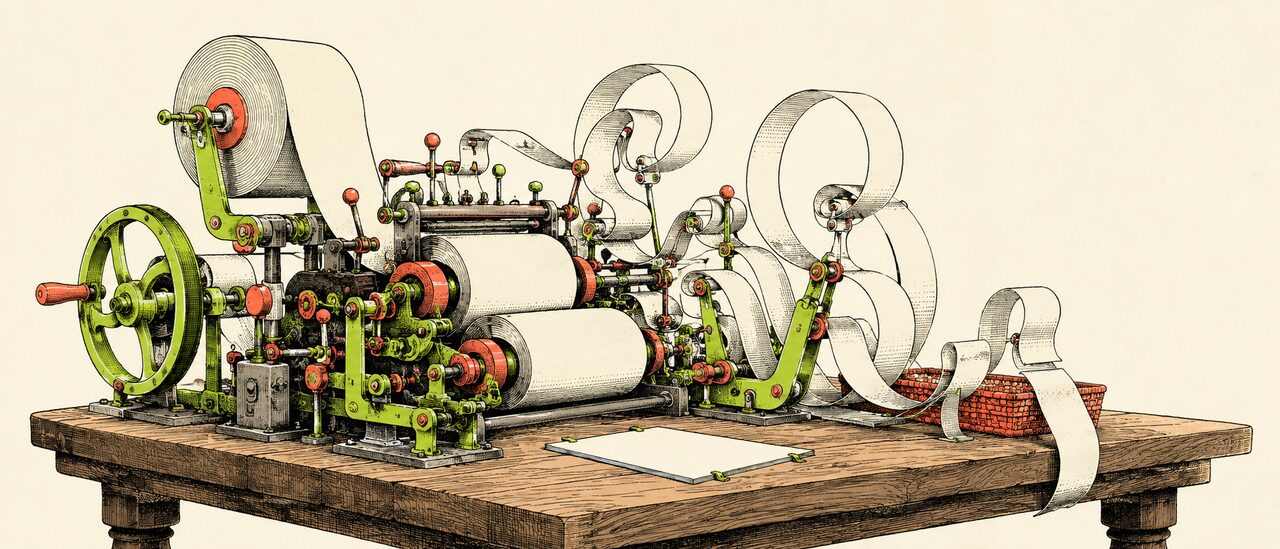
That little machine belongs beside the other social websites imagined as physical contraptions. Mine has a large handle connected directly to the same display. The handle is exceptionally well maintained.

The historical site was a social system
There is a real research question underneath the fictional narrator’s fussing. Historical Digg let people submit links and vote on stories. Attention did not arrive simply because the submitter had finally settled on a headline.
Kristina Lerman and Aram Galstyan’s 2008 study of social voting patterns examined stories submitted in June 2006. They distinguished interest spreading through a submitter’s social neighborhood from interest spreading beyond it. Their reported results associated broader spread with greater eventual popularity in that sample.
A separate 2007 study of user participation described uneven contributions and followed top-user activity over a year. Those are observations about a particular historical community. They are not a current ranking formula, a guaranteed promotion method or proof that a particular rejected link deserved better.
The limited point is enough for our narrator. There were other people involved. Other people are notoriously difficult to optimize while sitting alone with a headline document.
The emergency improvement arrives right on time
Just before publishing, I notice that the article could use another image. The image suggests a new opening. The opening makes the ending look weak. The revised ending raises a question the middle does not answer.
This is excellent news. The article has become a project again, which means it cannot yet become something people judge. I create a new folder to celebrate the progress.
Some revision is necessary. The joke is the moment revision stops serving the reader and starts protecting the writer from finishing. Our narrator has crossed that line so quietly that the checklist still describes the activity as quality control.
The cycle resembles the changing emotional requirements in the phases of owning an iPod. The object stays fairly ordinary. The owner keeps finding a new job for it. Here, an article has been promoted into a device for postponing an uncomfortable moment.
A smaller assignment for the link
Eventually, the fictional narrator can give the article a task it can actually perform. Explain the printer observation. Make one useful distinction. Give the interested reader a reason to continue. None of those assignments requires a prediction about the entire internet.
The headline can describe what is inside. The introduction can start where the interesting part starts. A person who reads it can disagree without invalidating the existence of the document.
I would like to say that our narrator accepts these terms immediately. Unfortunately, the modest headline has inspired one final alternative. It is much more exciting. It promises to explain why nobody understands printers, and possibly civilization.
The article would still like to remain about the printer.