
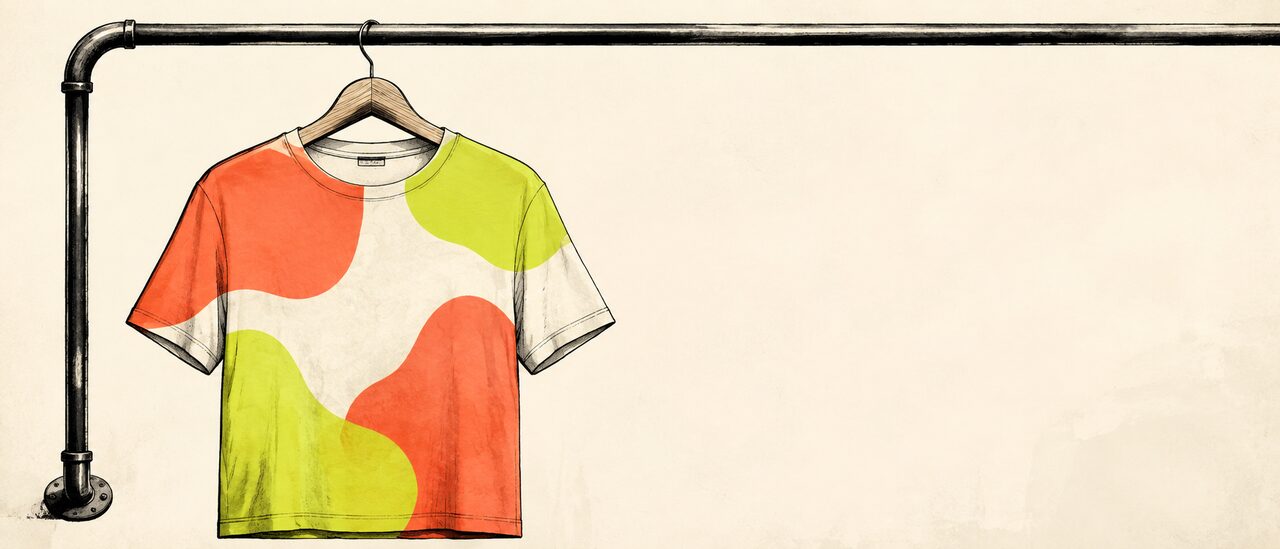
A Hypercolor shirt was a status display you could not turn off. Before a device on your wrist could announce that you had been moving around, a patch of changing fabric could make the same general observation with considerably less discretion.
The appeal is easy to understand. A shirt that changes color is more interesting than a shirt that remains the color you paid for. The complication is that the interesting behavior happens while you are wearing it. The demonstration and the customer are the same object.
The early 1990s craze faded quickly. The material idea did not vanish with it. To understand what happened to Hypercolor, it helps to separate the heat-sensitive effect, the difficulties of a garment that had to survive ordinary life, and the company trying to keep up with demand.
A plain shirt with a special effect
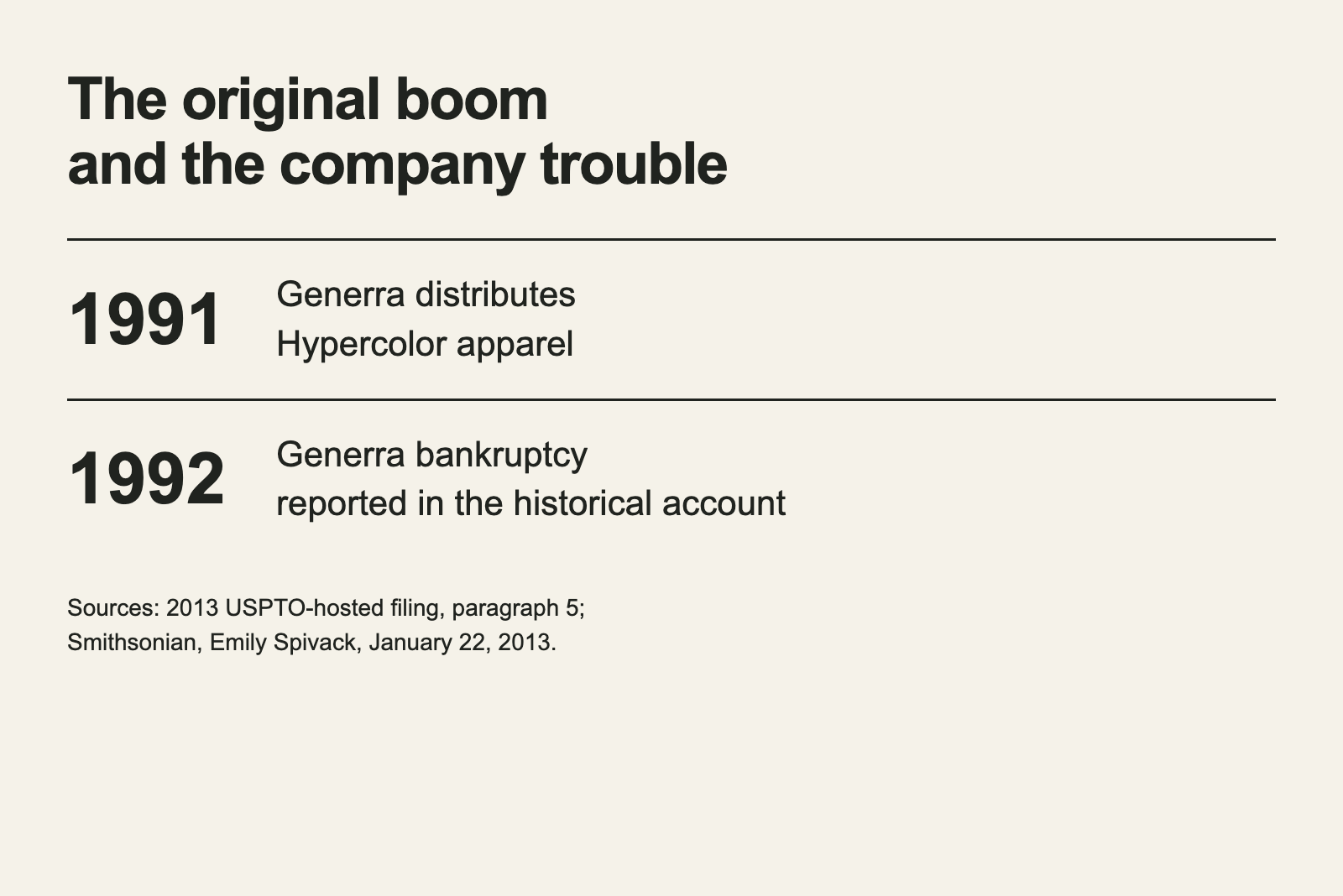
Generra was the company behind the original boom. A 2013 filing preserved by the USPTO dates its manufacture and distribution of Hypercolor apparel to early 1991. That document is a later party’s account of the brand’s history, rather than a contemporary diary of every shirt produced.
The central promise was simple enough to demonstrate without a manual: heat changed the color. You did not need to install anything, pair anything or agree that the shirt could send notifications. It had already decided to provide notifications.
Imagine the product meeting. Somebody has proposed a garment that responds to its wearer. The demonstration goes well. The fabric changes, everyone leans closer, and nobody has yet asked what happens during a crowded train ride. That is an invented meeting, but it captures the gap between a good demonstration and a whole day with a product.
The color change was real chemistry
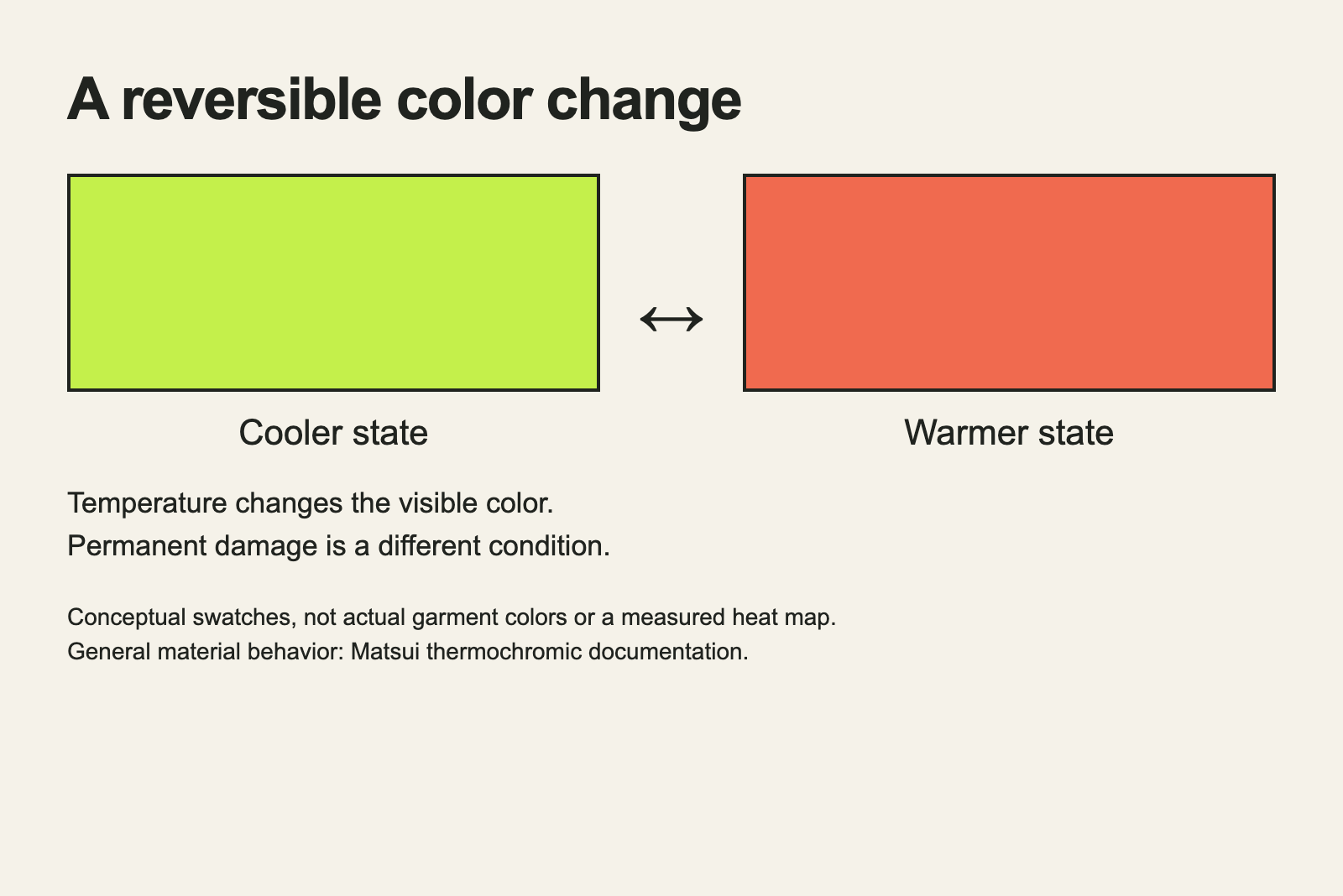
Thermochromic describes a color change associated with temperature. Matsui’s technical information on its temperature-sensitive colorants describes reversible coloring and decoloring. For the Chromicolor products discussed there, color disappears at higher temperatures and appears at lower temperatures.
That is useful background for the effect. It is not a recipe for an original Hypercolor garment. The manufacturer’s current product page covers several materials, and it would be careless to treat every formulation on that page as the contents of a particular shirt from 1991.
The conceptual distinction is enough for this story. A reversible effect can change with temperature and change back. Damage that prevents the effect from working is a different event. A shirt returning to its earlier color as it cools is doing its job; a shirt that has permanently lost the trick is not merely taking a break.
Software has a familiar version of this confusion. A screen can display a temporary state, or it can be stuck. From a distance, both look like a screen displaying a state. The person responsible for support would prefer that the difference be visible before the complaint arrives.
The shirt still had to be washed
Emily Spivack’s Smithsonian history of Hypercolor describes laundering problems that could spoil the color-changing effect. The same account places Generra’s bankruptcy in 1992 and discusses overproduction and management difficulties during the boom.
Those are related parts of the history, but they are not interchangeable explanations. A fabric’s durability problem does not, by itself, explain a company’s finances. A company having trouble does not mean the underlying color-changing phenomenon was imaginary. Both the product and the business had to work beyond the initial demonstration.
There is a very ordinary requirement hidden inside every exciting garment: eventually it goes in the laundry. A feature that makes a shirt remarkable does not remove the shirt’s less glamorous duties. The care label remains part of the product, even if nobody puts it at the center of the advertisement.
This article is not a care guide for vintage clothing. An old garment’s actual label and condition matter. No universal temperature setting or promised restoration trick follows from the general chemistry explanation.
A wearable interface with no settings page
Hypercolor is especially funny from a software-design perspective because the input and output are so close together. Heat is the input. A visible patch is the output. The wearer does not get a chance to approve the update before other people see it.
In a fictional modern version, the shirt would offer a privacy menu. You could choose whether the sleeves were allowed to share with the chest. A premium account would let you delay updates until you had left the meeting. The fabric would ask to restart at an inconvenient moment.
That joke belongs beside our social networks drawn as physical machines. Both ideas become clearer when you look at the behavior they encourage, rather than the name printed on the product. A changing patch tells the room something. The interesting question is whether the wearer wanted the room to know.
There is also the familiar excitement of getting a device that does one new thing. Our seven phases of owning an iPod revisit that progression from fascination to ordinary ownership. With Hypercolor, the new thing was attached to an object you already understood. The shirt was familiar. The shirt’s willingness to report on you was the surprise.
The effect outlasted the craze
Matsui’s continuing technical descriptions are enough to show that temperature-sensitive colorants remain a real product category. They do not establish that a current item is the original Hypercolor formulation, or that any new clothing line has recreated the original commercial moment.
That distinction leaves room to enjoy the old idea without turning nostalgia into a false product claim. A brief fashion craze can produce a memorable object. A memorable object can depend on useful chemistry. Neither requires us to pretend that every shirt worked forever.
The cleanest answer is that the original boom ran into practical garment problems and business trouble, while the broader color-changing technology continued. The shirt had found a way to make heat visible. Unfortunately, it could not make the laundry instructions equally interesting.