
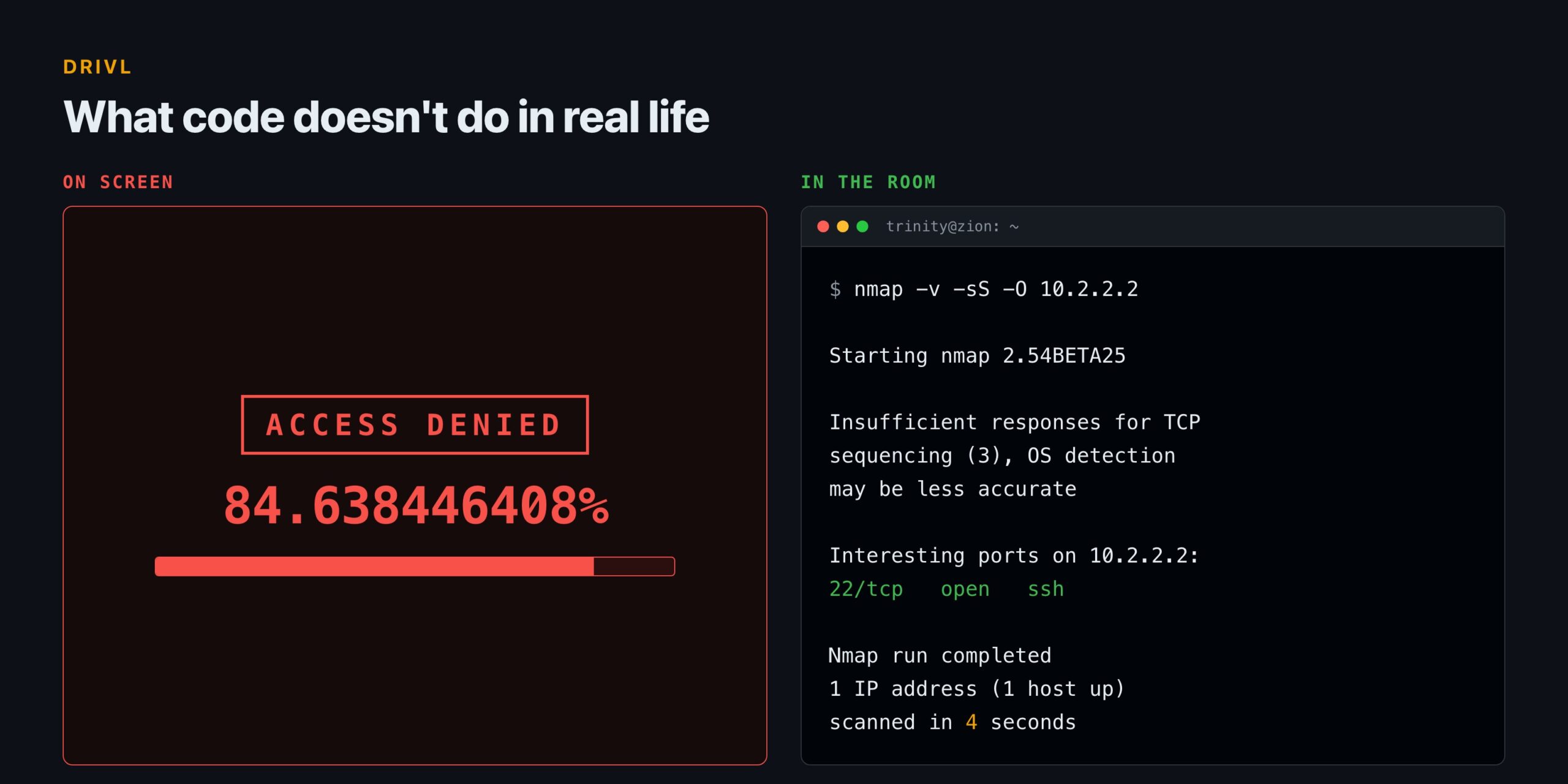
The computer in Jurassic Park looks invented. Some of the code in more sober-looking film terminals is borrowed set dressing. The appearance of a screen is a poor guide to whether the software behind it makes sense.
These examples separate the real programs from the jobs the script gives them. A file browser can be authentic while the emergency unfolding around it remains pure cinema.
Jurassic Park: the file browser was real
Lex sits down at a workstation, says “It’s a UNIX system! I know this!”, and navigates a green 3D grid to lock the doors. It became shorthand for Hollywood inventing nonsense computers.
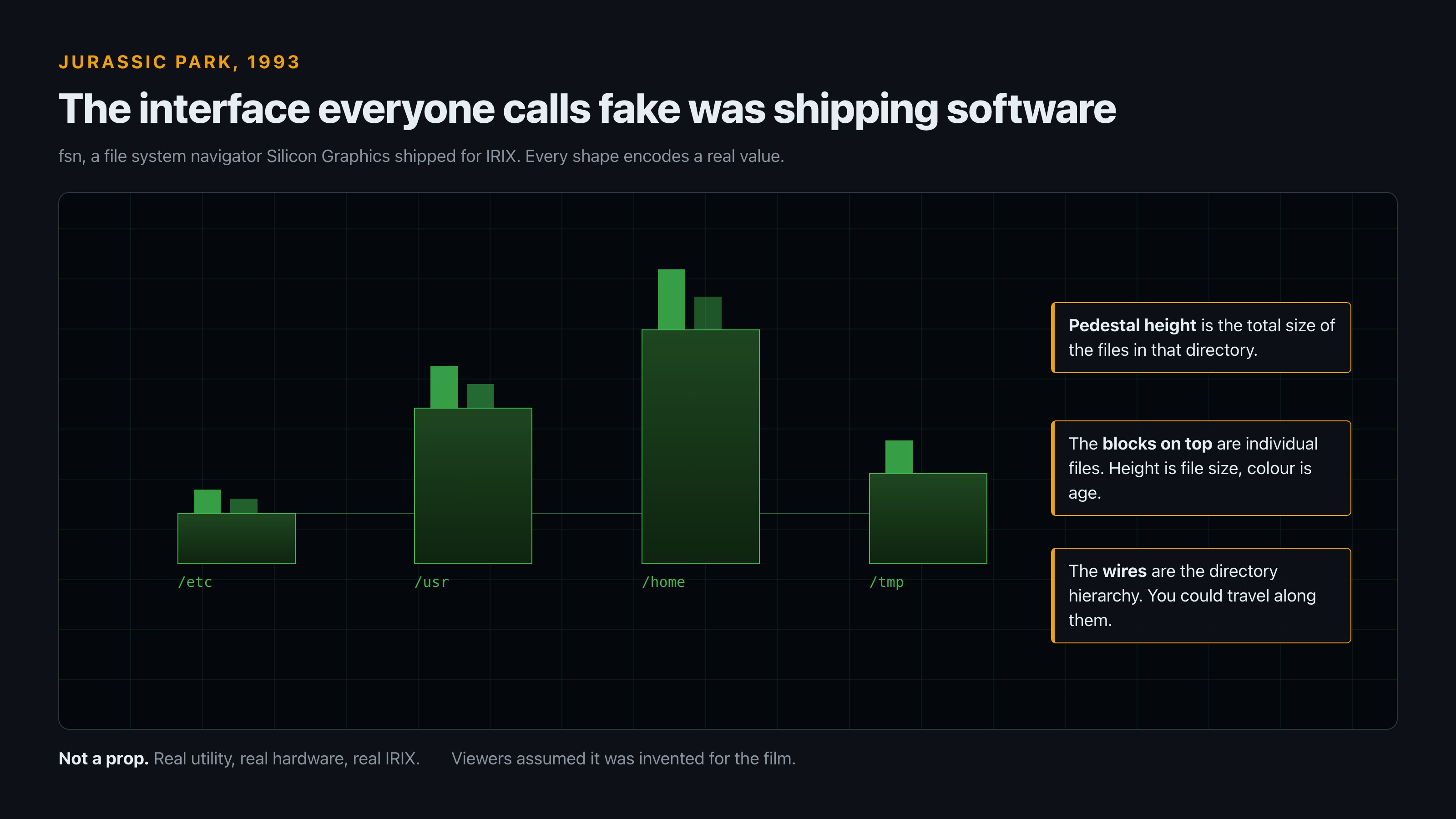
Lex is using fsn, a Silicon Graphics file-system navigator for IRIX. The history of its open-source successor, fsv, identifies the program shown in the film.
The blocks and platforms represent files and directories. They give the audience something it can watch Lex move through. That is a much better cinematic prop than a folder full of equally named backups, even if the backups are more familiar.
The Terminator and Elysium: borrowed text
John Graham-Cumming’s Source Code in TV and Films collects identifications of text visible on screen. Its examples include CPU documentation in Elysium and assembly language in The Terminator.
A production can borrow authentic text without borrowing its purpose. A processor manual does not become space-station software because somebody puts it behind an urgent progress bar.
From a cinema seat, a dense block of monospace text does the job. The mismatch appears when someone pauses the frame and reads it. Our look at fictional computer interfaces follows the production-design side of that problem.
The Matrix Reloaded: a real tool, a compressed story
The Nmap project’s film catalog identifies Trinity’s scanner and the real SSH vulnerability behind the scene in The Matrix Reloaded. The fictional follow-up tool is called sshnuke.
That makes the scene more grounded than a glowing tunnel through a firewall. It still packages a series of discoveries into a few dramatic actions. The fact that the scanner exists cannot establish every step that follows it.
Mr. Robot: the person becomes part of the attack
Hackaday’s first-season review points to visible commands and social-engineering scenes in Mr. Robot. Those details give the work a sequence the viewer can follow.
The useful dramatic choice is to make access depend on people. A conversation or a misplaced device can matter before a terminal appears. The character has something to do beyond typing harder at a password box.
Independence Day: getting the systems to talk
David Levinson delivers a computer virus to an alien ship in Independence Day. The scene asks the audience to accept a connection between two systems whose compatibility is mostly left unexplained.
The missing work is what makes the shortcut funny. Before useful code can run, there must be a way to transmit it and a system capable of interpreting it. A plug that fits would settle very little.
Sam Hughes offers a defense of the scene based on the captured alien craft humans have already studied. It is a reading of the story, not evidence that a consumer laptop could improvise the same connection.
A progress bar gives the audience a deadline
Much of the interesting work in software is invisible: reading, checking an assumption, realizing the first idea was wrong. An action film needs to make the stakes legible while that happens. A progress bar is wonderfully cheap exposition.
The trouble begins when the graphic appears to know something the story has never established. How does a password search know it is 97 percent finished? What exactly has the character measured?
That convenient certainty belongs with the other movie cliches that let a script skip difficult work. Sometimes it is an acceptable shortcut. Sometimes the shortcut is the entire scene.
Next time, look for the connection between the action and the result. The real program in a ridiculous scene deserves credit. The impressive terminal still has to explain what happened.