
A place slogan is a small sign volunteering an entire community for a very large promise. The residents have jobs, errands and opinions about parking. The sign has decided they are all participating in a permanent state of excellence.
The easiest way to make a slogan sound bad is to read it as an instruction. That is the game here. These are real examples of place branding, followed by deliberately literal jokes. The towns and cities are not being ranked, and nobody’s quality of life has been inferred from a line on a website.
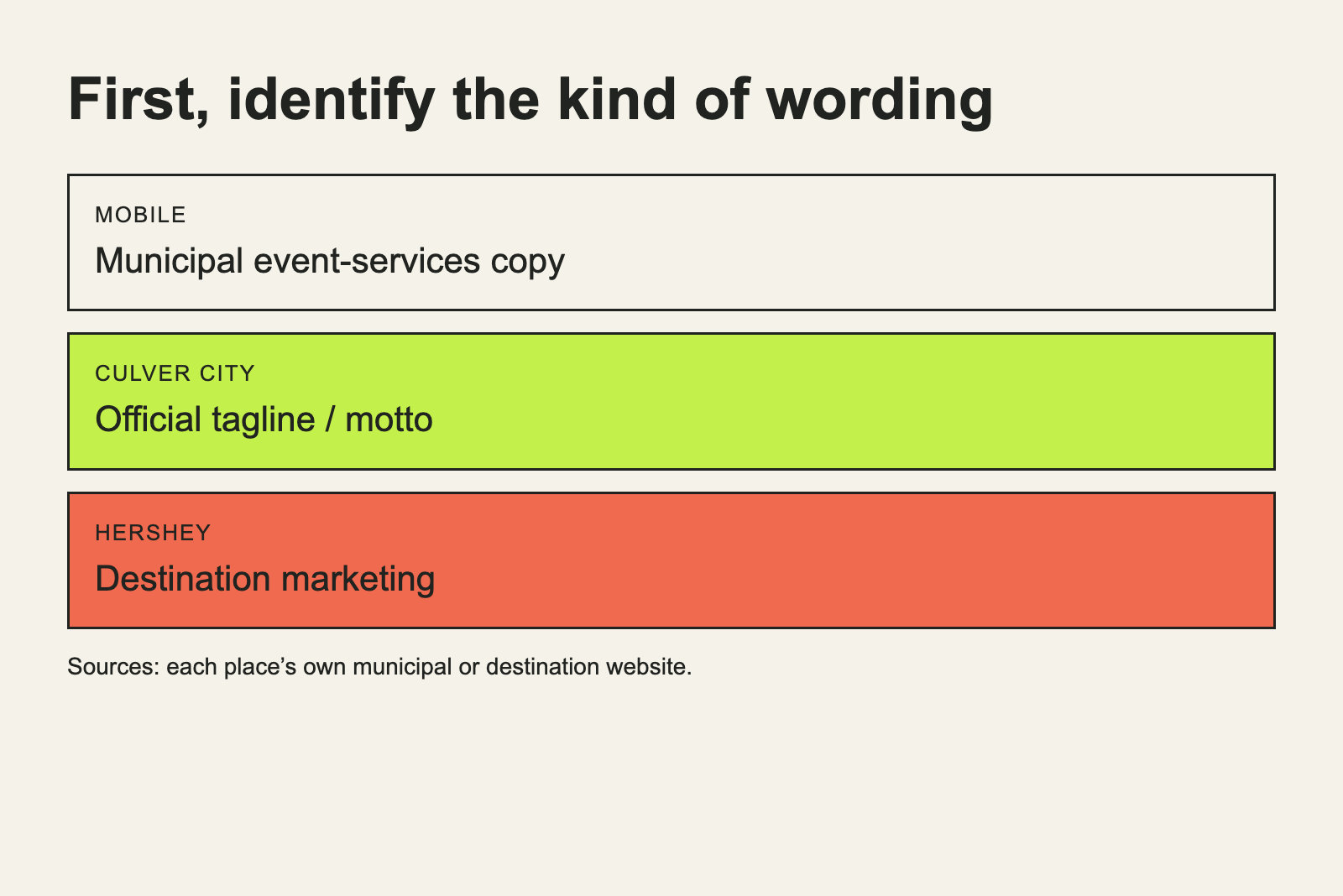
The distinctions matter. A municipal motto, a line in city copy and a tourism brand are not the same thing. Before making fun of the words, we should at least identify who is using them.
Mobile: a celebration with paperwork
Mobile’s official event services page says that Mobilians are born to celebrate. It is a cheerful opening to information about organizing events. The phrase belongs to actual city copy, rather than a quotation invented for this list.
Read literally, it creates a demanding civic schedule. What happens on an ordinary Tuesday when someone would prefer to buy light bulbs and go home? Must the purchase be festive? Is there a reduced celebration requirement for people waiting for a delivery?
The funny part is the meeting of an expansive promise and an administrative task. The page quite reasonably helps people plan gatherings. The imaginary literal reader hears a lifelong obligation to maintain the atmosphere.
That tension is also why the wording works better than a generic claim of greatness. It gives the mind something to picture. A slogan with enough personality to support a joke has already done more than one that could sit under any town’s name.
Culver City: please identify the rest of Screenland
Culver City’s municipal media page lists “The Heart of Screenland” as its tagline and motto. Here the source identifies a specific official use. We do not have to promote an anonymous internet nickname into city policy.
The metaphor immediately supplies an imaginary map. If this is the heart, where is Screenland’s elbow? Which neighboring district handles its accounts? Does the whole organism stop for lunch at the same time?
Of course, a heart can mean a center of activity or identity. The deliberately unhelpful reading is to treat that metaphor as a planning document. Suddenly, a compact civic phrase has created an entire anatomical geography that nobody asked to maintain.
This is the occupational hazard of a memorable image. People can take it somewhere strange. A safer phrase might avoid the problem, but it would also be less likely to stay in anyone’s head long enough to be misused.
Hershey: a superlative with a very large comparison group
The Hershey destination website uses “The Sweetest Place On Earth.” This is destination branding for Hershey, Pennsylvania. It is not presented here as a municipal ordinance or as evidence that Hershey is an incorporated city.
The literal-minded visitor has questions about the comparison. Was every place assessed? Were the samples the same size? Has someone checked the cupboard where a relative keeps the emergency baking supplies?
None of those questions is a serious objection to the marketing line. Its chocolate association is obvious. The joke comes from treating an affectionate superlative as a research finding and appointing oneself the auditor.
The phrase also illustrates the difference between memorable branding and useful directions. It tells a visitor what sort of association to expect. It does not tell them where to park. A destination needs room for both kinds of sentence.
The slogan workshop has become nervous
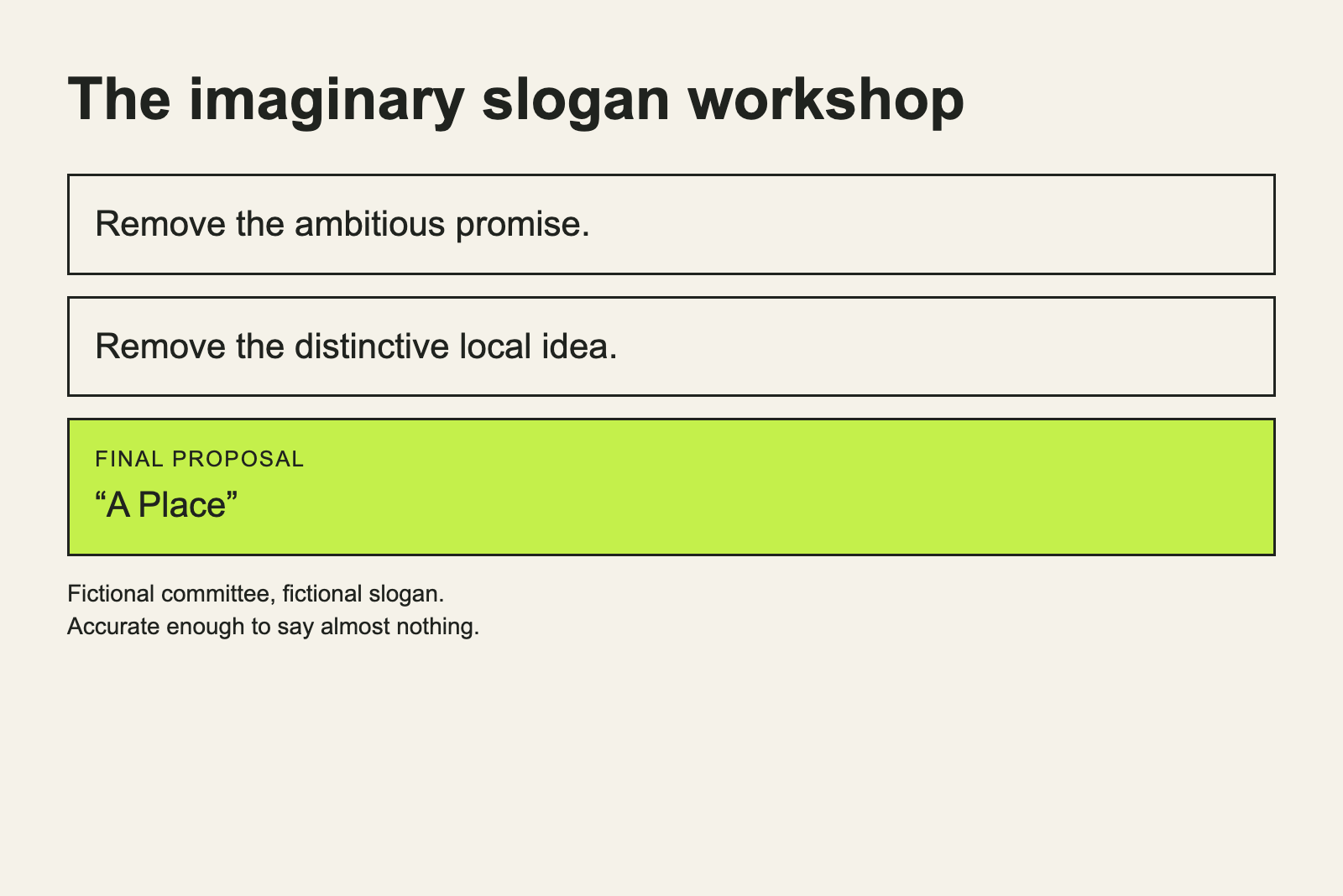
Now imagine a fictional town trying to avoid every possible joke. The committee starts with an ambitious phrase. Someone observes that it could be interpreted literally. The committee removes the ambition.
The next version mentions a local feature. Someone worries that people who do not like that feature will feel excluded. The committee removes the feature. The third version expresses enthusiasm. Someone asks whether enthusiasm is appropriate in all weather conditions.
After a productive afternoon, the town has arrived at “A Place.” It is accurate, inclusive of the available geography and almost impossible to criticize. It is also doing very little work.
The problem was never that a slogan could support a joke. The problem would be a slogan so empty that nobody could tell which place it belonged to. Avoiding all risk of interpretation is a good way to produce wording that nobody bothers to interpret.
Names and mascots have the same awkward job
A few words cannot contain everything about a community. Neither can a name or a mascot. They offer an entry point, and the audience brings its own associations to the meeting.
That is why real place names that sound like bad test data can be funny without making the places themselves the target. The surprise lives in the reader’s expectation. The map is simply getting on with its work.
Our look at unusual college mascots has a similar appeal. A distinctive identity is easier to remember and easier to joke about. Those qualities can coexist without requiring an apology from the people who use it.
Leave the slogan one reasonable job
A good place-branding line can create an association, express local pride or give a visitor a reason to look closer. It cannot carry every detail of a destination, and it should not have to pretend that daily life is a continuous promotional video.
For the fictional committee, I would keep the specific local idea and let the practical website supply the practical information. The slogan can be enthusiastic. The opening hours can remain literal.
Then the residents can buy their light bulbs in peace. Unless they feel like celebrating, in which case the event services page is ready to help.