
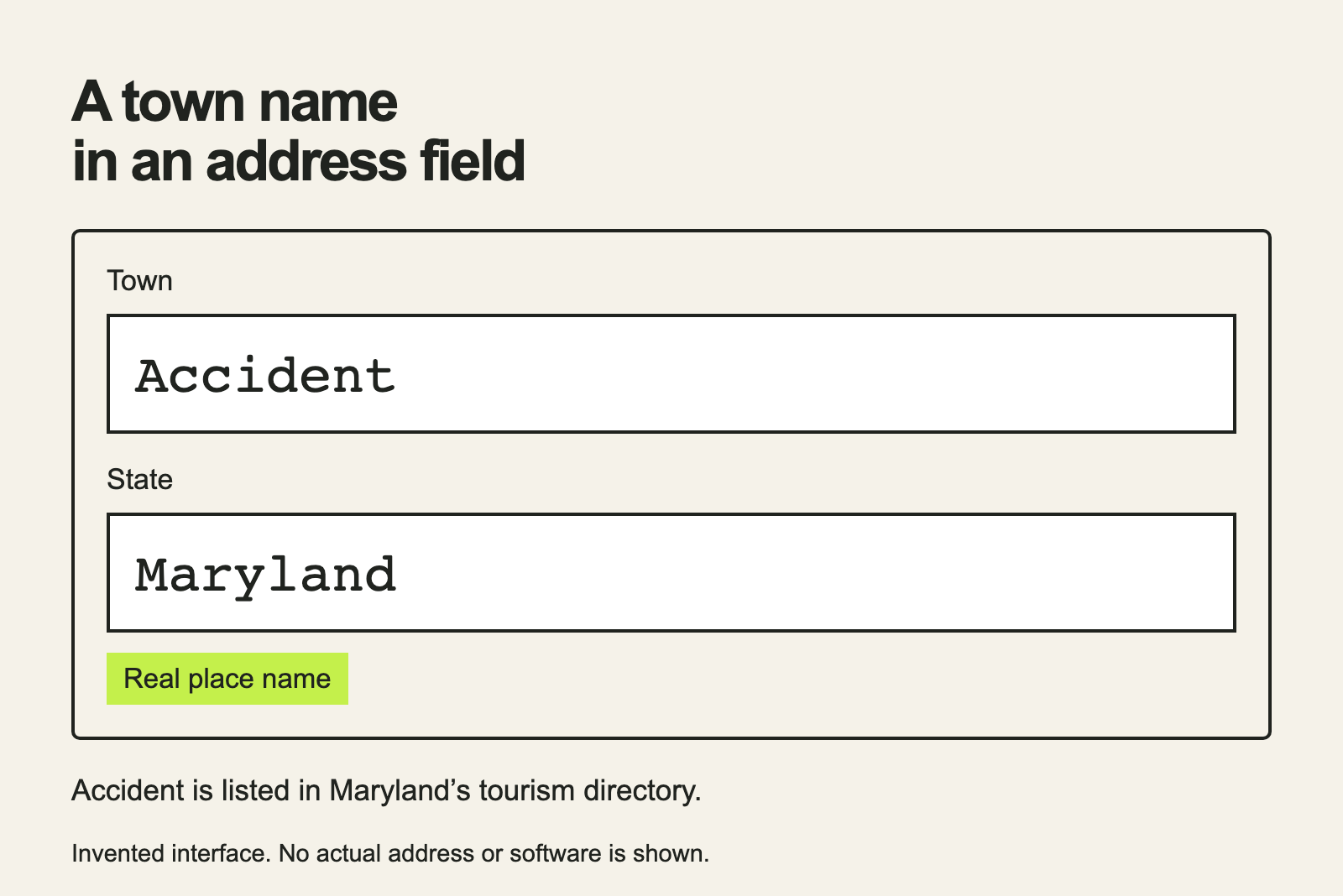
Accident, Maryland looks like the value someone left in a test database. You can almost see the ticket: replace fake towns before launch. Then you check the map and discover that the town is real, the field is correct, and your confidence was the bug.
The worst place names in the world depend heavily on what you find funny. For a developer, a name that sounds like an error message has an unfair advantage. These ten real names have that quality. Some have documented explanations; others are better left with a question mark than a suspiciously tidy origin story.
A name is only part of what a reader sees. The surrounding box supplies its own assumptions, which is why drawing social networks as ridiculous machines can explain a familiar interface better than another screenshot.
A place name can surprise a reader without trying. Place slogans taken too literally show what happens when a few extra words deliberately promise something memorable.
Boring, Dull and Bland
Boring in Oregon
Boring gets straight to the point. It sounds like the destination your calendar would choose for you after declining a holiday request. A weekend in Boring could be wonderful and still read badly on the leave form.
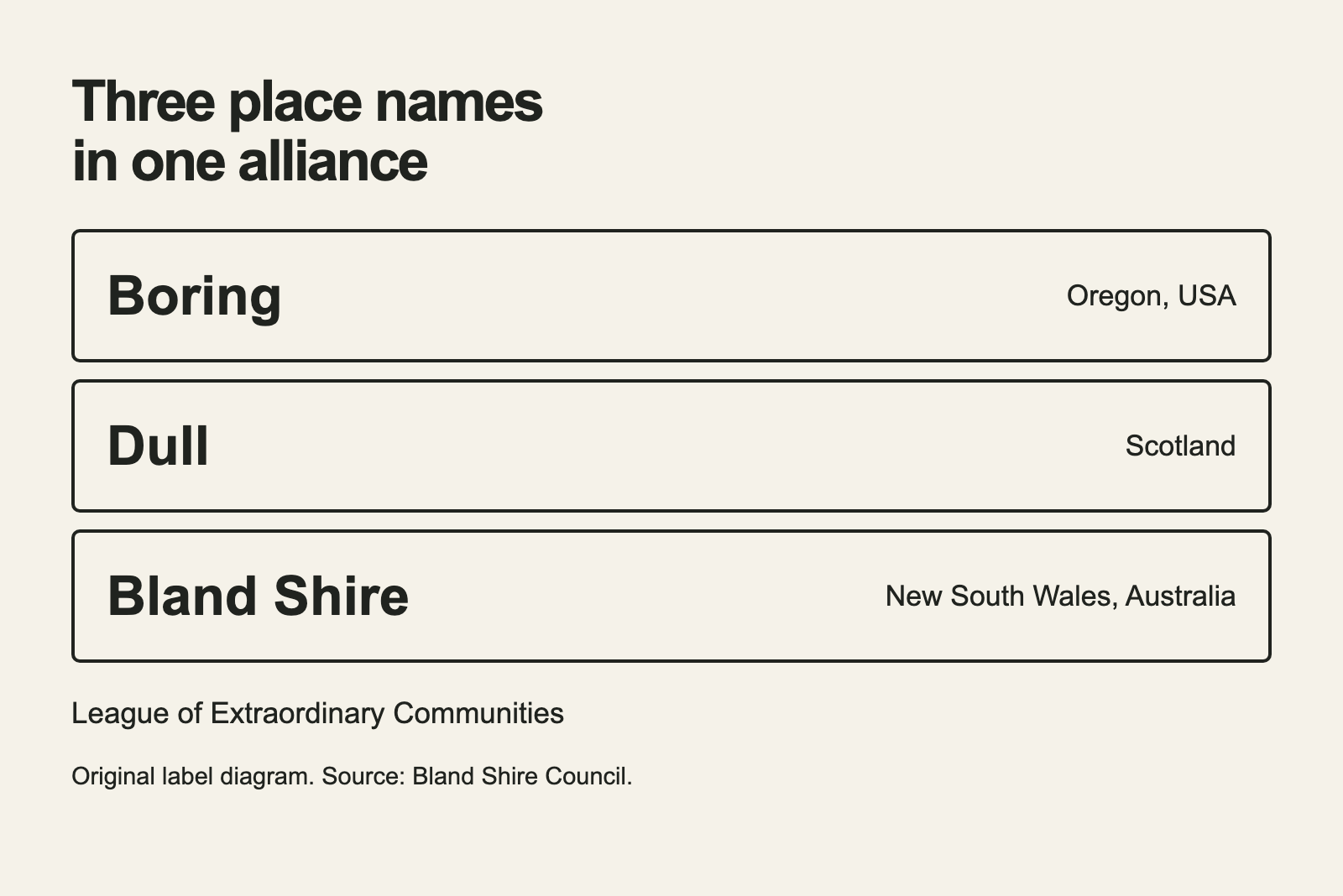
There is a better joke than the obvious one. Boring joined forces with Dull in Scotland, and Bland Shire in Australia joined the alliance. The Bland Shire Council account confirms the relationship. Someone took three names that look like rejected marketing copy and gave them a shared public identity.
Dull in Scotland
Dull is the Scottish member of the group. It has the economy of a one-word code review. No explanation, no suggested fix, just Dull.
As a place name, it also creates an impossible assignment for a travel writer. You can praise the scenery for six paragraphs and the headline still says Dull. The council gives a possible historical explanation for the name, but presents it as a belief. We can enjoy the present-day English meaning without pretending that settles the etymology.
Bland in New South Wales
Bland Shire completes the set. Put the names in a dropdown and they sound like three levels of a product you would struggle to sell: Boring, Dull, and Bland Enterprise. The sales team would insist the last one includes priority support.
The alliance is a much more cheerful response than paying someone to replace the name with an abstract word ending in “ify.” Public names can gather a life of their own, as the college mascots that outgrew a simple label make clear. You can spend years explaining the original idea while everybody else enjoys a different one.
Place names for an incident report
Accident in Maryland
Maryland’s tourism directory includes Accident among its destinations. It sits there as an ordinary location, without the apologetic tone you would expect from a word usually followed by a damage estimate.
Consider a perfectly innocent message: “The package has arrived in Accident.” Your logistics dashboard now sounds like it has bad news. Add a shipment status called “Exception” and the whole screen becomes a conversation you would rather have on Monday.
That is a joke about the wording, of course. We have no evidence that the town causes delivery software any trouble. A real address is allowed to sound funny. Any validation rule based on whether a developer finds it plausible has a short and embarrassing future.
Hell in Michigan
Hell makes every directions request sound personal. “How do I get to Hell?” is a normal question for a map and a difficult opening for a conversation with your manager.
Michigan’s official tourism page makes full use of the name, describing postcards and themed attractions. There is ice cream in the pitch. That is a strong improvement over the version most of us were warned about.
The naming advantage is hard to miss. Plenty of destinations need a tagline to give their souvenirs a point. Hell can print its name and go home. A visitor can send a postcard with the confidence that the recipient will supply the joke.
Truth or Consequences in New Mexico
Truth or Consequences sounds like the dialog box before a destructive database operation. There should be a checkbox saying you understand the risks, followed by a button nobody wants to press.
The city’s own history dates the change from Hot Springs to 1950. The state tourism department explains the connection to Ralph Edwards’ radio show promotion. The name began as publicity, which gives every modern marketing meeting a fairly alarming precedent.
Changing a button label can require three rounds of approval. Here was an entire town taking the name of a show. You have to admire the willingness to ship the change, even if you would want a very careful look at the rollback plan.
Names that need a second look
Dildo in Newfoundland and Labrador
Dildo is a real community in Newfoundland and Labrador, and the name has already done most of the comic work before this paragraph starts. An overconfident profanity filter would have a terrible time being useful here.
The more interesting detail is how uncertain the explanation remains. The provincial tourism account offers several possibilities and leaves the origin unsettled. That is a good place to leave it. A funny name does not become more interesting because someone attached an invented fact to it.
Imagine being the person who has to report that the address filter rejects their hometown. Somewhere, a developer is preparing to explain that the filter works as designed. That developer should keep reading the ticket.
Batman in Türkiye
Batman has an official provincial culture and tourism office. Its website contains ordinary administrative information, which is a useful correction if your brain has already supplied a cape.
In an address field, Batman is geography. On a cinema listing, the same string sends you somewhere else. The joke belongs to the reader who brought the wrong context. No comic-book origin story is needed to make it work.
A movie computer would probably identify the intended meaning from a dramatic close-up of the keyboard. Real software has to deal with context more carefully, one of the recurring problems in what code does in movies. A few extra characters in the country field can do more useful work than a wall of green text.
Place names with their own plans
Come By Chance in Newfoundland and Labrador
The Canadian Geographical Names Database records Come By Chance as an official town. It is a lovely name to encounter in a source designed to remove ambiguity.
In ordinary conversation, it sounds like the explanation for arriving somewhere without testing the route. “How did the deployment reach production?” “Come By Chance.” Please attach the logs.
It also gives a navigation app an awkward sentence to say aloud. You can arrive at Come By Chance with a carefully planned itinerary. The destination will still take the credit for improvising.
Happy Adventure in Newfoundland and Labrador
Happy Adventure appears as a town name in a Newfoundland and Labrador government record. Even a municipal document has to let a little optimism through when that is the name in the heading.
It sounds like the working title of a game whose developer has not reached the save-system bugs yet. Every adventure is happy while the first level runs on the machine that built it.
Put Happy Adventure and Come By Chance on the same imaginary release schedule and you have the beginning and end of a familiar project. Somebody will eventually suggest renaming the difficult part. Accident is already taken.